Unleash the Terror: Crafting Horror Design with the Death Rattle Font
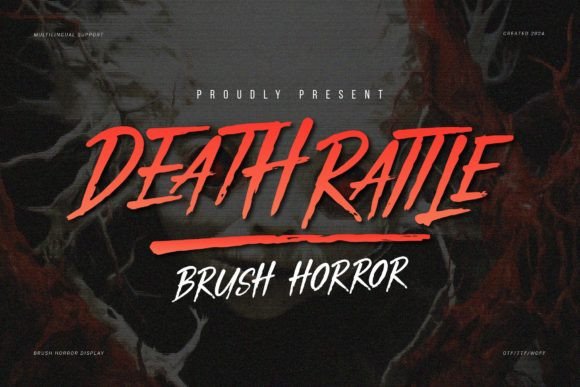
You know the feeling when you walk through a haunted attraction and every surface seems to drip with dread? That visceral, unsettling atmosphere isn't an accident; it is a result of meticulous design choices. For visual creators, achieving that specific "creepy" vibe often comes down to typography. If you are working on a project that demands a sense of foreboding, danger, or the macabre, standard serif or sans-serif fonts simply won't cut it. This is where a specialized display typeface becomes your most valuable asset. Enter Death Rattle, a font that doesn't just spell out words—it screams them. With its jagged edges and rough, torn texture, this typeface captures the essence of a horror movie title card or a warning scrawled on a dungeon wall.
The Anatomy of Fear: What Makes Death Rattle Visually Distinct
Understanding why this font works requires looking at the psychology of shapes. In modern typography, we generally associate rounded shapes with safety and sharp angles with danger. Death Rattle leans heavily into the latter. The letterforms look as though they were scratched into wood or torn from paper, creating a texture that feels organic and chaotic. Unlike a clean, vectorized geometric font, this typeface has "tooth." The edges are uneven, the lines are rugged, and the overall silhouette is aggressive. This visual noise creates immediate tension, making it an incredibly effective tool for grabbing attention. It is a premium font designed specifically to disrupt the visual peace, making it perfect for scenarios where you want the viewer to feel uneasy or alert.
Real-World Applications: Beyond the Halloween Poster
While it is an obvious choice for October-themed flyers, the utility of a font like Death Rattle extends far beyond seasonal decorations. Its distinct personality makes it a powerful design asset for various creative industries.
- Packaging Design: Imagine a craft brewery releasing a limited-edition stout named "Graveyard Shift" or a hot sauce brand called "Demon's Breath." Using this typeface on the label immediately communicates the intensity of the product. It tells the customer this isn't a mild flavor; it’s an experience.
- Brand Identity for Niche Markets: Heavy metal bands, escape rooms, haunted attractions, and horror-themed podcasts rely on aggressive typography to signal their genre to their audience. A logo design utilizing these jagged letterforms acts as a filter, instantly attracting the target demographic and repelling those who aren't interested.
- Editorial and Book Covers: If you are designing a cover for a thriller novel or a horror anthology, the title needs to jump off the shelf. Death Rattle provides the necessary contrast against a dark background, ensuring the text is legible yet stylistically terrifying.
- Merchandise and Apparel: T-shirts, hoodies, and stickers featuring horror aesthetics are a massive market. A creative font like this allows designers to create graphics that look vintage and distressed without needing complex Photoshop effects.
Practical Typography: Pairing and Readability
Because Death Rattle is a high-impact display font, it requires a specific approach to typography rules. You wouldn't use it to write a blog post or a paragraph of body copy; the jagged edges would cause eye strain over long periods. Instead, it is strictly for headlines, titles, and short bursts of text.
To achieve a professional presentation, you must master the art of font pairing. Because Death Rattle is complex and textured, it pairs best with something simple and clean. A sturdy sans-serif font like Helvetica, Roboto, or a clean modern sans-serif works beautifully as a counterweight. The contrast allows the headline to be the star of the show while the body text remains highly readable. When testing your pairings, ensure there is enough white space around the jagged letters so the texture doesn't bleed visually into the rest of your layout.
Ensuring Visual Consistency Across Platforms
One of the challenges with textured fonts is maintaining consistency across different mediums. A design that looks crisp on a high-resolution monitor might lose some of its detail when printed on a specific material. When using Death Rattle for branding materials, it is crucial to test the typeface in various contexts.
For web design, ensure the font loads correctly and renders well on mobile screens, as the jagged details might look like pixelation on lower-resolution devices if the font size is too small. For print materials, always do a test run. The "rough" look of the font needs to contrast with the smoothness of the paper. If you are printing on textured cardstock for an invitation or a poster, ensure the ink doesn't fill in the negative space of the letters, which could ruin the effect. This attention to detail separates amateur designs from professional, high-quality assets.
Licensing and Commercial Use
For designers and entrepreneurs, the legal aspect of typography is just as important as the aesthetic. When investing in a creative font like this, you must verify the licensing terms. Most premium fonts come with specific licenses depending on usage.
If you are a freelance designer creating a logo for a client, you generally need to ensure the license allows for commercial use and if it needs to be embedded in digital files (like PDFs or apps). If you are a small business owner creating your own marketing assets, you need a license that covers the number of impressions or prints you anticipate. Always review the End User License Agreement (EULA) included with the font files. This ensures your brand identity is built on solid legal ground, avoiding potential issues down the road.
Elevating Your Visual Communication
Ultimately, typography is about communication, and sometimes, standard words aren't enough to convey the mood. Death Rattle offers a solution for those moments when you need to bypass the polite facade and get straight to the raw emotion of the design. It is a specialized tool for specialized jobs. Whether you are a content creator looking to spice up YouTube thumbnails, a game developer designing UI elements for a scary level, or a marketer creating a flash sale poster, having a font with this much character in your toolkit can save the day. It allows you to instantly set the tone, engage your audience, and create a visual narrative that lingers long after they have looked away.